cloutaro
Best Time to Post on Instagram: Your Insights Beat Every Table
Universal best-time tables disagree for a reason. Where your insights show real audience hours, and a three-week test.
Best Time to Post on Instagram: Why Your Insights Beat Every Table on the Internet
Search this topic and you will find dozens of confident tables: post at 9 a.m. on Tuesday, at 7 p.m. on Friday, never on Sunday. Read three of those guides side by side and they disagree with each other, which is the first honest data point: if a universal best time existed, everyone would print the same one.
Why the universal tables disagree
Those tables are averages over millions of accounts, mixed across niches, countries and audience ages. An average over a fitness page in Los Angeles, a bakery in Warsaw and a meme account in Jakarta describes none of them. The tables disagree because each provider averaged a different soup. None of them ever met your audience, and your audience is the only one whose active hours pay you anything.
Where Instagram shows your audience's real hours
If your account is set to professional (business or creator), Instagram hands you the answer for free. Open your profile, go to the professional dashboard, then into your audience insights, and look for most active times. You can read it by hour and by day. Two details matter: the chart describes your current followers, not the strangers you hope to reach, and the hours are shown in your audience's activity pattern, which is what counts if your followers sit in a different time zone than you do.
Reading the chart like an operator
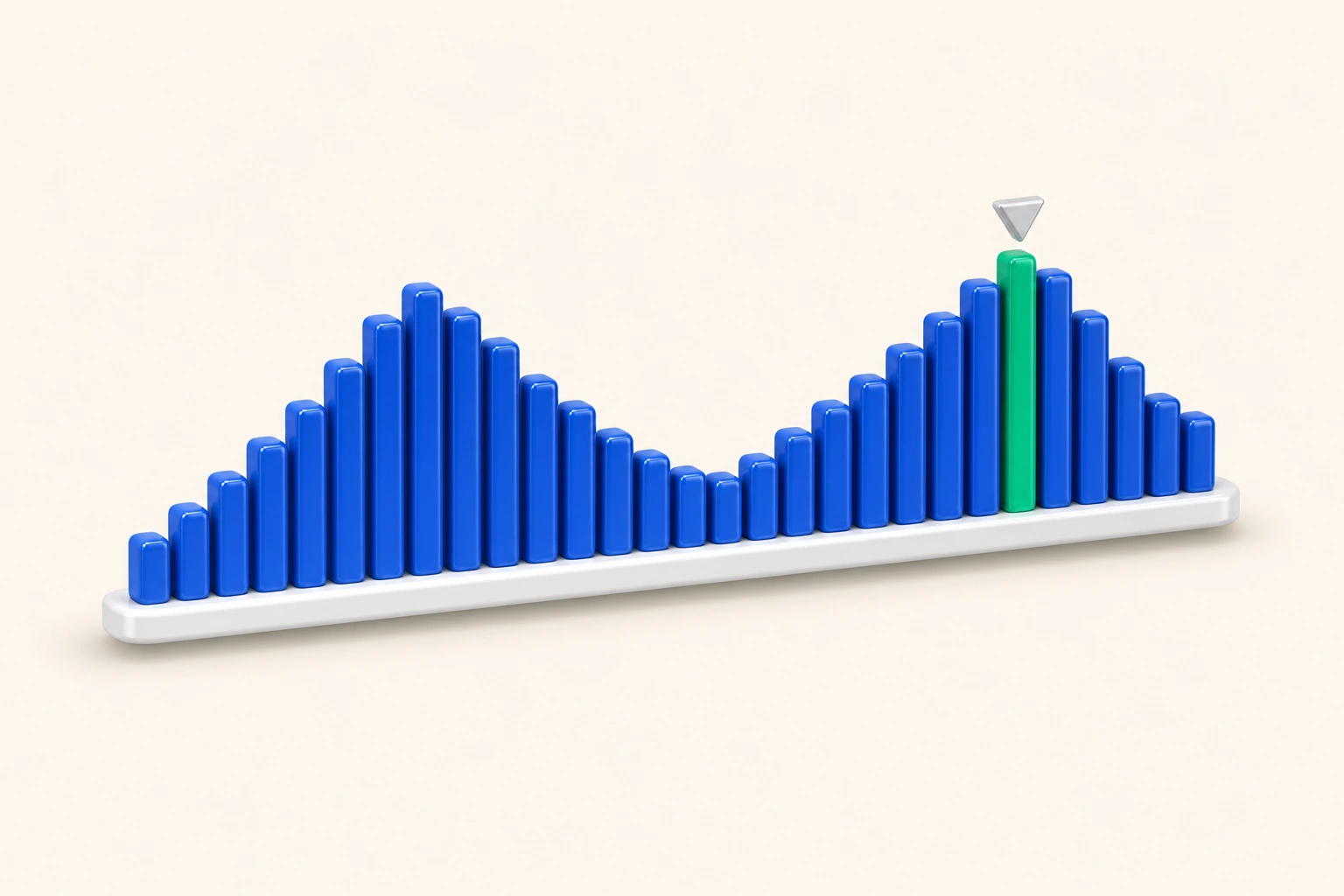
The peaks are not the whole story. What you want is the climb before a peak: a post published shortly before your audience's active window is fresh when they start scrolling, instead of already buried under everything published at the peak itself. Look separately at weekdays and weekends, because most accounts have two different audiences by rhythm: the commute-and-lunch crowd on weekdays, the late-morning scrollers on weekends.
Format changes how much timing matters
Timing is not equally important for every format. A story lives for 24 hours, so its clock matters most: publish it at the start of an active window and it collects its audience all day. A feed post or carousel does most of its collecting in the first day but keeps trickling. Reels are the loosest case, because their distribution can stretch over days; a strong reel published at an odd hour usually finds its audience anyway. If you can only time one thing carefully, time your stories and treat reel timing as a lower-stakes decision.
The three-week test that settles it for your account
Instead of trusting any table, including this article, run the boring experiment. Keep the content type constant, pick three candidate windows from your insights, and rotate them across three weeks: window A in week one's Monday slot, window B in week two's, and so on. After each post, note the first-hour reach and the 24-hour reach from your insights. Three weeks in, you have your own table, built from the only audience that matters. Repeat the exercise every few months, because audiences drift.
When timing is not the actual problem
One honest caveat from the operator side: if your posts perform the same at every hour, and that performance is flat, timing is not your bottleneck. A feed whose recent posts sit at two-digit view counts reads as a quiet room no matter when you publish into it. That is the layer our catalog covers with Instagram views, priced per 1,000 in plain text. Fix the room, then let your insights fine-tune the clock. For the organic layer, our guides on getting more followers and how hashtags actually work now cover the rest of the machine.
Buy Instagram Views
Reels and Feed views that move the public counter where everyone can see it.
Buy nowFrequently asked questions
No, and the proof is that the published tables all disagree. Active hours depend on your audience’s niche, country and daily rhythm, which is exactly what your own insights chart measures.
About the author